

Best budget smartwatch under $50 for fitness tracking 2026

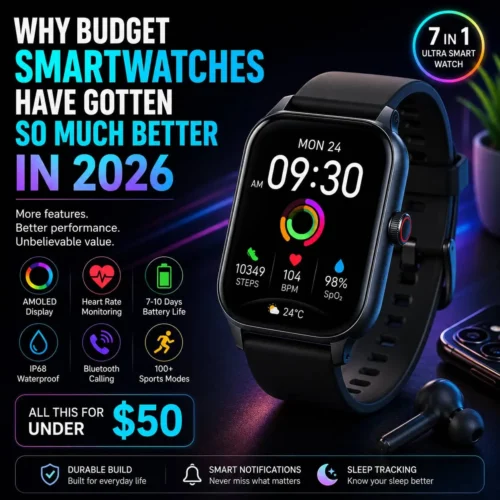
Table of Contents
Why Budget Smartwatches Have Gotten So Much Better in 2026
Three years ago, spending under $50 on a smartwatch meant accepting a pretty rough experience. Laggy touchscreens, inaccurate health tracking, Bluetooth that dropped every ten minutes, and displays you couldn’t read in sunlight. The hardware just wasn’t there at that price.
That’s genuinely changed.
AMOLED displays — the kind that give you deep blacks and bright colors — are now common in smartwatches well under $50. Heart rate sensors have improved dramatically. Battery life on budget watches now regularly hits 7-10 days, which is actually better than some expensive smartwatches that need nightly charging. And the software, while still not on the level of Wear OS or watchOS, has gotten smoother and more reliable.
The ceiling for what fifty dollars buys you on your wrist has moved up significantly. The floor — the worst stuff — is still pretty bad. That gap is what this guide is about.
What You Can Realistically Expect From the Best Budget Smartwatch Under $50
Before getting into specifics, it’s worth setting honest expectations. Here’s what the good options at this price actually deliver in 2026:
A proper AMOLED or IPS display that’s readable outdoors. Continuous heart rate monitoring that’s reasonably accurate for daily tracking. Sleep tracking. Blood oxygen (SpO2) monitoring. Step counting. Multiple sport modes — usually 100+ on most models. Smartphone notifications. Battery life of 7-10 days.best budget smartwatch under $50in Water resistance at IP67 or better. Bluetooth calling on some models.
That’s a genuinely useful feature set for most people’s daily needs.
What you’re not getting: built-in GPS accurate enough for serious runners, ECG monitoring, the tight app ecosystem of Apple Watch or Galaxy Watch, or premium build materials. Those things genuinely require spending more. But if your needs are daily health tracking, notifications, and something that looks decent on your wrist — fifty dollars gets you there in 2026.
best budget smartwatch under $50
What to Actually Check Before Buying a Budget Smartwatch
Most people look at the pictures, check the star rating, and order. That’s how you end up returning things.
Here’s what actually matters: best budget smartwatch under $5
Display Type Matters More Than Screen Size
An AMOLED display at 1.7 inches is dramatically better than an LCD display at 1.9 inches. AMOLED gives you better contrast, true blacks, and visibility in sunlight. LCD screens on budget watches often look washed out outdoors and drain battery faster. When a listing mentions “HD display” without specifying the type — that’s usually LCD. Look for AMOLED specifically.
Battery Claims — Apply the Same 25% Rule
Same as with earbuds — advertised battery life is tested at minimum brightness in ideal conditions. Real-world battery life with always-on display, active notifications, and regular health tracking is usually 25-30% lower than the advertised number. A watch claiming 10 days typically delivers 7. Plan for that.
Check the Strap and Case Size
This sounds obvious but people miss it. A 46mm case looks massive and uncomfortable on a smaller wrist. Most budget watches don’t advertise case dimensions clearly. Check the product images carefully — look at how it sits on the model’s wrist. If you have a smaller wrist, look specifically for watches described as 42mm or under.
App Compatibility With Your Phone
Budget smartwatches connect through their own companion apps — not Google Fit or Apple Health directly in most cases. Before buying, search the companion app name on the App Store or Google Play and check the reviews. A terrible companion app ruins even a decent smartwatch. If the app has thousands of one-star reviews complaining about connectivity, the smartwatch experience will be frustrating regardless of the hardware.best budget smartwatch under $50
IP Rating for Water Resistance
IP67 means it can handle being submerged up to 1 meter for 30 minutes. IP68 is better — deeper submersion. 5ATM means it’s safe for swimming. If you want to wear a smartwatch during workouts, swimming, or in the shower, verify the actual IP or ATM rating rather than trusting vague claims of “waterproof.”
The 7 in 1 Smartwatch — What That Actually Means
You’ve probably seen smartwatches marketed as “7 in 1” or even higher. It sounds impressive. Here’s what it actually refers to.
A 7 in 1 smartwatch typically means the watch comes with multiple interchangeable straps or faces that dramatically change the look of the watch. Instead of buying one watch that looks one way, you get a watch that can look like seven different watches depending on which strap or dial you put on it.
For the price, it’s genuinely good value. You get versatility — a sport strap for the gym, a more formal-looking face for work, something casual for weekends — all from one purchase. The core hardware and features stay the same, but the wearability across different contexts improves a lot.
If you’re someone who wants a best budget smartwatch under $50 that doesn’t look the same every day, or if you’re buying one watch to cover multiple situations, the 7 in 1 format makes real practical sense. Check out the 7 in 1 Ultra Smart Watch for a good example of what this looks like in practice.
Best Budget Smartwatch Under $50 — Who Should Buy One
Not everyone needs a smartwatch. But if you fall into any of these categories, a solid budget option makes complete sense in 2026.
You want basic health awareness without obsessing over data. Step counts, heart rate trends, sleep patterns — a budget smartwatch gives you enough information to understand your general health without drowning you in metrics you’ll never use.
You’re a student or young professional who wants notifications on their wrist so they’re not constantly pulling out their phone in class or meetings. best budget smartwatch under $50 handle this well.
You’re trying smartwatches for the first time. Spending $300 on your first smartwatch when you’ve never worn one before is a genuine risk — you might hate wearing something on your wrist, or discover the features you thought you’d use daily aren’t actually that useful in practice. Starting at $50 is the smart move.
You want a gym companion. Heart rate monitoring during workouts, step and calorie tracking, water resistance, and music controls — a good budget smartwatch covers all of this without the anxiety of sweating on something expensive.
You want to give one as a gift. For parents, grandparents, teenagers, or anyone who’s curious about smartwatches but would never spend $200+ on one themselves — a quality budget option is a genuinely thoughtful gift that won’t feel like a cheap throwaway.
Features That Are Actually Worth Having at This Price
With so many features listed on budget smartwatch pages, it’s easy to get distracted by things that sound impressive but don’t matter much in daily use best budget smartwatch under $50
Heart rate monitoring — actually useful. Continuous heart rate data gives you a baseline understanding of your resting heart rate trends over weeks, which is genuinely meaningful health information.
Sleep tracking — useful if you pay attention to it. The data won’t be as precise as a medical device, but trends in your sleep duration and patterns are accurate enough to be actionable.
SpO2 (blood oxygen) — less useful for most healthy people in daily life, but good to have. Useful for people at altitude, with respiratory conditions, or who just want a broader health picture.
Bluetooth calling — surprisingly useful on models that have it well-implemented. Being able to answer calls from your wrist without pulling out your phone is genuinely convenient, not just a novelty.
Always-on display — nice to have but kills battery life. On a budget watch with a 7-day battery, enabling always-on display often cuts that to 3-4 days. Worth evaluating whether you actually need it.
Built-in GPS — rare and usually inaccurate at this price. Most budget watches under $50 use connected GPS through your phone. That’s fine for casual tracking but not reliable for serious running or hiking routes.
What to Ignore on Budget Smartwatch Listings
“100+ sport modes” — having 100 sport modes sounds impressive. The reality is that most of these modes are minor variations of basic step and heart rate tracking with a different name attached. What matters is whether the modes you actually use — running, walking, cycling, gym — work well. The total number is mostly a marketing number.
“AI health monitoring” — at this price, AI health features are usually basic algorithms that flag irregular heart rate readings. It’s useful but not the sophisticated AI analysis that premium devices offer. Don’t let this claim drive your decision.
Claimed battery life over 15 days — possible on watches with tiny displays and minimal features, but on a watch with a proper AMOLED screen and active health tracking, 15+ day claims are almost always inflated. Treat anything over 10 days with significant skepticism.
“Military grade durability” — a marketing term with no standardized meaning. Check for actual IP ratings and ATM water resistance ratings instead.
How to Make a Budget Smartwatch Last Longer
A few habits that significantly extend the lifespan of budget smartwatches:
Don’t charge it to 100% every time. Lithium batteries in smartwatches degrade faster when kept at full charge for extended periods. Charging to around 80% and topping up when it drops to 20% extends battery lifespan meaningfully. Battery University has a detailed breakdown of why this matters for all lithium-based devices.
Take it off during charging. Wearing a watch while it charges generates heat from both the charging process and your body contact. Heat is the primary enemy of lithium batteries — removing it during charging keeps temperatures lower.
Clean the sensors on the back. Sweat, skin oils, and debris build up on the optical sensors on the back of the watch over time, which affects tracking accuracy. A soft damp cloth on the back sensors once a week keeps readings accurate.
Update the firmware when updates are available. Budget watch manufacturers do push meaningful improvements through firmware updates, particularly for health tracking accuracy and Bluetooth stability. Check the companion app occasionally for available updates.
Budget Smartwatch vs Fitness Band — Which Makes More Sense?
This is a question worth addressing because they’re often compared at similar price points.
Fitness bands — like the Xiaomi Smart Band or Huawei Band series — are slimmer, lighter, and tend to have better battery life at the same price. They’re excellent for health tracking, sleep monitoring, and notifications. What they lack is the full watch face experience, larger display, and features like Bluetooth calling.
Budget smartwatches give you a bigger screen, more customization, watch-like aesthetics, and features like call answering — but at the cost of slightly more bulk and usually shorter battery life than a band.
For pure health and fitness tracking without caring much about the watch experience, a fitness band often delivers better accuracy per dollar. For people who want a watch that also tracks health, a budget smartwatch is the right call.
We cover smartwatch battery life optimization in detail in our Smartwatch Battery Life Tips guide — worth reading once you’ve made your purchase to get the most out of it.
The Honest Verdict on Budget Smartwatches in 2026
Spending under $50 on a smartwatch used to feel like a compromise. In 2026 it genuinely doesn’t anymore — at least not for most people’s actual needs.
The best budget smartwatch under $50 in 2026 gives you a bright AMOLED display, accurate enough health tracking for daily awareness, a week of battery life, and features that would have cost three times as much just a few years ago. That’s a real shift.
What hasn’t changed is the need to shop carefully. The market is full of products that look identical to the good ones in photos but cut corners on the sensors, displays, and software that make the difference between a watch you wear every day and one that ends up in a drawer. Use the checklist in this guide, look for real verified reviews across multiple months, and verify the companion app quality before you commit.
Do that and you’ll find something that actually earns a place on your wrist.
Related Reading From FusionsHub
- 7 in 1 Ultra Smart Watch — Full Details
- Smartwatch Battery Life Tips — 7 Hacks to Save Power
- Best Wireless Earbuds Under $30
- Why Is My Phone Charging Slow?
- Original vs Fake — Real Danger Buying Guide
People Also Ask
Are budget smartwatches under $50 actually good in 2026? For everyday use — step tracking, heart rate monitoring, sleep tracking, notifications, and basic fitness — yes. The technology at this price point has improved significantly. AMOLED displays, 7-10 day battery life, and reliable Bluetooth are all achievable under $50 now. You’re making tradeoffs on GPS accuracy and app ecosystems, but for most daily users those tradeoffs are completely acceptable.
What is a 7 in 1 smartwatch? A 7 in 1 smartwatch comes with multiple interchangeable straps and watch faces that change the entire look of the watch. Instead of one fixed design, you get seven different style options from one purchase — sport, formal, casual, and more. It’s particularly good value for people who want a versatile watch that works across different situations and outfits.
How long does a budget smartwatch battery actually last? Advertised battery life is always tested under ideal conditions. In real-world use with active notifications, heart rate monitoring, and regular display use, expect around 25-30% less than the advertised number. A watch claiming 10 days typically delivers 7 in daily use. Turning off always-on display and reducing notification frequency extends this further.
Can I use a budget smartwatch for running? Yes for casual running — step count, heart rate, and calorie tracking work well. For serious runners who need accurate pace and distance data, budget smartwatches under $50 that use connected GPS through your phone are acceptable but not ideal. Standalone GPS accurate enough for serious training typically requires spending more.
Is a budget smartwatch or fitness band better under $50? Fitness bands are slimmer, lighter, and usually have longer battery life at the same price. Smartwatches have larger displays, more features like call answering, and a proper watch aesthetic. If health tracking is your primary goal, a band often delivers better accuracy per dollar. If you want a complete watch experience with health features, go with a smartwatch.
What should I look for in a cheap smartwatch? AMOLED display, IP67 or better water resistance, Bluetooth 5.0 or higher, at least 7 days of real battery life, and a companion app with decent reviews on the App Store or Google Play. Those five things filter out most of the bad options quickly. Check for verified reviews spread across multiple months rather than a sudden burst of reviews in one week.
Do budget smartwatches work with iPhone? Most do, through their own companion apps. The experience is generally better on Android because Apple restricts third-party app integration more than Google does. On iPhone, you’ll get notifications and basic health tracking but some features — like responding to messages from the watch — may not work as smoothly as on Android. Always check the companion app iOS reviews specifically before buying.
Looking for a smartwatch that covers your bases without an expensive price tag? The 7 in 1 Ultra Smart Watch gives you real versatility — seven different looks from one watch, with the health tracking features you actually need day to day