

Fast Charging Battery Damage: Is Your Cheap Charger Safe?

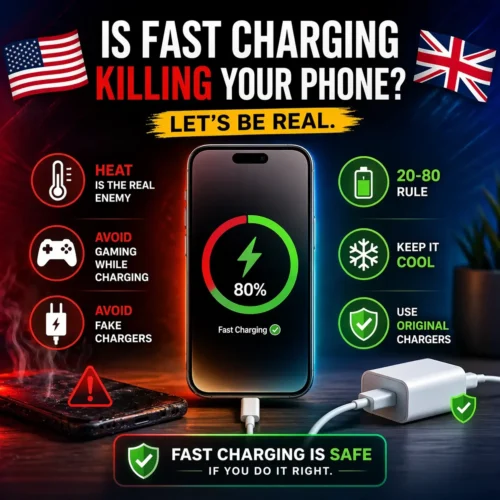
Fast Charging Battery Damage Actually Killing Your Phone? Let’s Talk Reality.
Look, I get it. You just dropped over 2 lakh rupees on a flagship phone. It’s thin, it’s fast, and it’s your life. But then you plug it into that 65W “Super” brick, and suddenly the back of the phone feels like it’s ready to fry an egg.
Your heart sinks. You start Googling stuff like “Is my charger a killer?” or “Will I need a new battery by December?”
Every single day at my store, Fusions Hub, I deal with this exact panic. Customers walk in, grab a fast charger, and then look at me like I’m handing them a ticking time bomb. They ask: “Sagheer bhai, will this cause fast charging battery damage?” It’s the #1 fear in tech today. People are literally addicted to checking that ‘Battery Health’ percentage like it’s their bank balance.
But here’s the thing—after years of testing gear, I can tell you that the charger isn’t the real villain. It’s actually how we use (or abuse) our phones that does the dirty work.
1. The “Smart Sponge” – How Charging Really Works
First, forget the fire hose analogy. Your battery isn’t a bucket being blasted with water. It’s more like a smart sponge.
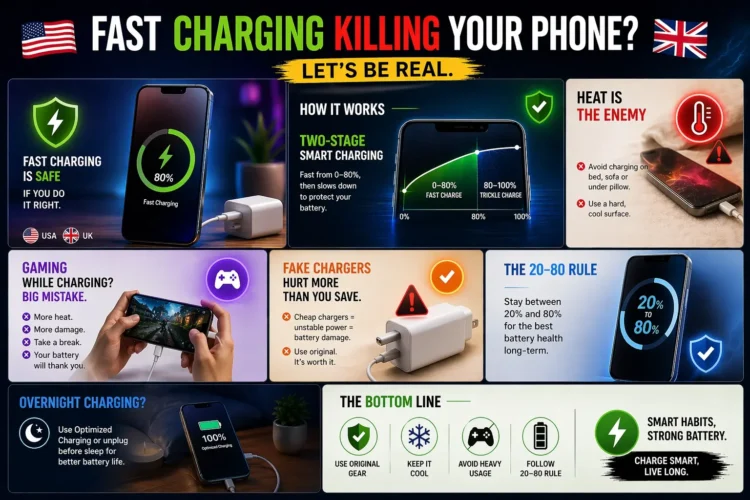
When your phone is empty (0-20%), it’s thirsty. It sucks up power at max speed. This is the “Blast Phase.” But once it gets to about 80%, the phone tells the charger to “chill out.” It slows down the electricity to a trickle. Why? To prevent fast charging battery damage. If your phone was “dumb” and kept pushing 65W at 100%, it would catch fire.
Tech experts at CNET (USA) have proven this over and over. The speed isn’t what kills the battery; it’s the side effects that come with that speed.
2. The Real Killer is Heat (No, Seriously)
If you remember only one thing from this massive guide, let it be this: Heat is the silent assassin. Lithium batteries are chemically very sensitive. When they get hot, the liquid inside starts to break down. Fast charging creates heat—that’s just basic physics. But we make it ten times worse. We charge our phones on beds, pillows, or sofas. Fabric is an insulator; it traps the heat inside the phone. You are basically slow-cooking your battery cells from the inside out.
If you want to fix mobile overheating issues, just put the phone on a hard, cold surface like a wooden table. Give it some air. This simple move alone can stop 90% of fast charging battery damage.
3. Gaming While Charging? Please, Just Don’t.
I see this constantly. A guy is in the middle of a PUBG match, his battery hits 10%, he plugs in the 65W cable, and keeps playing. STOP. This is the fastest way to ruin a phone. You’ve got heat coming from the fast charge, AND you’ve got heat coming from the processor working overtime. It’s a thermal disaster. I’ve seen batteries at Fusions Hub swell up like balloons because of this. Give your phone a 20-minute break. Your rank isn’t worth a 15,000 rupee battery replacement.
4. The “Cheap Charger” Trap
In our local markets, you’ll see “Master Copy” chargers for 800 rupees. The shopkeeper will swear it’s original. He’s lying to you.
A real OnePlus 65W Original Charger is heavy because it’s packed with safety chips. These chips regulate the voltage. Cheap chargers don’t have them. They send “dirty” power—voltage that jumps up and down. This “shocks” the battery cells. This constant micro-trauma is the biggest cause of fast charging battery damage. Don’t be “penny wise and pound foolish.”
verything you need to know about charging your smartphone safely in 2026.
5. The 20-80 Rule (The Holy Grail)
Batteries are like humans. We don’t like being totally starving (0%) and we don’t like being painfully stuffed (100%). We like the middle ground.
Charging your phone from 80% to 100% actually puts the most chemical stress on the battery. If you can keep your phone between 20% and 80%, you are winning. Even Apple (Global) now has a setting to stop charging at 80%. They know this is the best way to avoid fast charging battery damage.
6. Why “Fast” Doesn’t Mean “Dangerous”
A lot of people think 120W charging is 6 times more dangerous than 20W. It’s not. The higher the wattage, the more safety layers the manufacturer adds. The danger only comes when you use a low-quality cable or let the phone get too hot. If you treat a 120W charger with respect, it’s just as safe as a slow one.
7. Does Overnight Charging Matter?
Yes and no. Your phone won’t explode if you leave it plugged in all night. It stops taking power at 100%. But, keeping it at 100% for 8 hours every night is like holding a rubber band at its max stretch for 8 hours. Eventually, it loses its “spring.” Use the “Optimized Charging” feature in your settings to mitigate this specific type of fast charging battery damage.
8. The “Winter Jacket” Problem (Phone Cases)
We buy these huge, thick, rugged cases to protect against drops. But they are like winter jackets for your phone. When you fast charge, the heat needs to escape through the back of the phone. A thick rubber case traps it. If your phone feels hot, pop the case off. Let it breathe.
9. Software Matters More Than You Think
Manufacturers often send “Battery Optimization” updates. Sometimes a bug in an old version of Android or iOS can make the charging controller go crazy. Always keep your phone updated. It’s a hidden way to prevent fast charging battery damage.
10. Don’t Be a Slave to the Percentage
Lastly, stop stressing. If your battery health drops to 98%, your life isn’t over. Batteries are consumables. They are meant to die eventually—just like car tires. The goal of this guide is to make sure yours lasts 3-4 years instead of 1 year.
If you need gear you can actually trust, check out our Shop Page. We only sell stuff that we would use on our own phones.
FAQ – Clear Your Doubts
Q1: Can I use my 65W laptop charger for my phone? Yes. Your phone will only take the wattage it supports. The charger won’t “force” 65W into a 20W phone.
Q2: My phone is getting warm. Should I be scared? A little warmth is normal for fast charging. If it’s “ouch, that’s hot,” then unplug it. Usually, it’s a fake cable or you’re using the phone while it charges.
Q3: How often should I replace my battery? When your health hits 80% or below, it’s time. Until then, just follow the tips above to slow down the fast charging battery damage.
Final Word
Fast charging is a blessing. It saves us hours of sitting near a wall socket. Don’t fear it—just be smart with it. Use original chargers from a shop like Fusions Hub, keep the phone cool, and stop gaming while you’re plugged in.
What’s your battery health right now? Drop it in the comments, let’s see who’s winning!
One thought on “Fast Charging Battery Damage: Is Your Cheap Charger Safe?”