

Power Bank Buying Guide: 3 Mistakes to Avoid

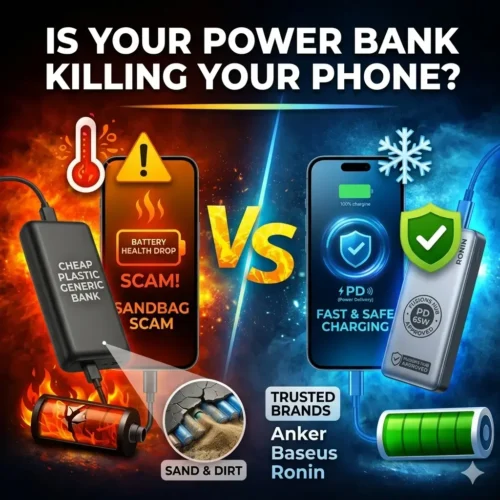
Table of Contents
Power Bank Buying Guide: 3 Mistakes to Avoid Before You Buy
Let’s be real for a second. We all hate that low battery warning.
You are out somewhere. No wall socket in sight. Your phone hits 10%. Panic kicks in. So what do most people do? They just jump on Amazon. Or they walk into a random local store. And they buy the first cheap portable charger they see.(Power Bank Buying Guide By Fusions Hub)
Huge mistake.
I have seen this happen so many times. People spend over a thousand dollars on a brand new smartphone. Then they trust a $10 random battery to charge it. It makes zero sense.
In this Power Bank Buying Guide, I am not just going to talk about price tags. I want to show you how to actually protect your battery health. And how to get that fast charge you actually paid for.
Avoid these 3 mistakes. Trust me, your phone will thank you.
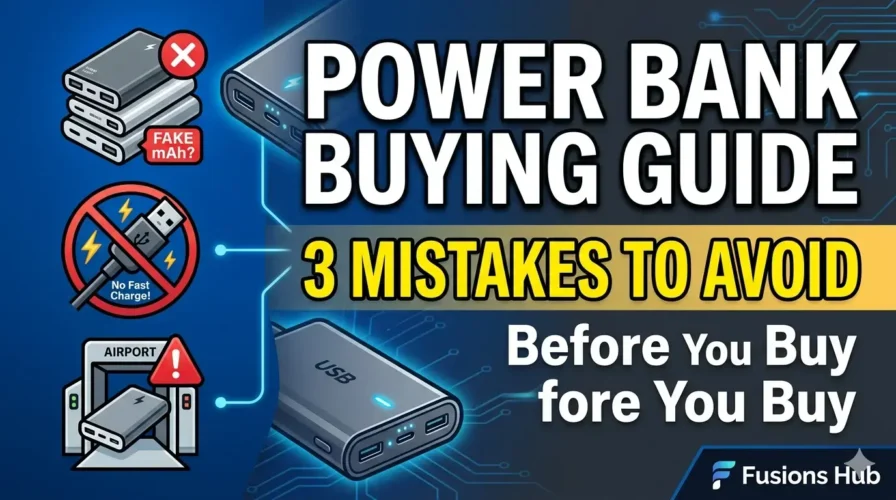
Mistake #1: Buying “Fake” High mAh Numbers
You see a deal on eBay. A massive 50,000mAh power bank for 20 bucks. Sounds amazing, right?
Wrong. It is usually a total scam.
Here is the truth. A lot of these cheap unbranded chargers use trash battery cells. They might work fine for a week. Then they die. Or even worse, they ruin your phone’s logic board by pushing bad voltage.
Also, you need to understand battery efficiency. No battery gives you 100% of its power. Heat and conversion take a cut. A good 10,000mAh bank will actually give you about 6,500mAh of real charging juice.
Always check the “Rated Capacity” on the back of the box. Any decent Power Bank Buying Guide will tell you this. Don’t fall for the big marketing numbers.
Mistake #2: Forgetting About USB-C Power Delivery
It is 2026 guys. If your power bank only has that old, big rectangular USB port, throw it away.
You need USB-C. But not just any USB-C. You need Power Delivery. Or “PD” for short.
Why? Because without PD, your phone charges at a snail’s pace. If you have a new iPhone or a Samsung, PD is the only way to trigger the fast charging icon.
And think about charging the power bank itself. A massive battery without PD takes like 12 hours to recharge. Nobody has time to wait for that.
Get a PD charger. You can find solid ones on Walmart easily. It cuts the recharge time down to just a couple of hours. Also, make sure your wires are actually good. You can check out our guide on identifying original vs fake chargers at Fusions Hub to make sure your cables are actually up to spec.
Mistake #3: Buying Airport Confiscation Hazards
People always forget about travel rules. You buy a giant power brick for your laptop. Then you get to the airport. And TSA throws it in the trash.
Airlines do not mess around with lithium batteries.
The limit is usually 100Wh. If your power bank doesn’t clearly show the Wh (Watt-hours) rating printed on it, security might just take it to be safe.
Safety is a big deal here.Buy Power Bank From Truste Source After Checking Power Bank Buying Guide
We see cheap batteries catch fire online all the time. Look for UL or CE marks. At Fusions Hub, we always say the same thing. Saving ten bucks is not worth burning down your bag.
🚀 The Quick Fix Summary
Don’t have time to read it all? Here is the cheat sheet.
Ditch the no-name junk. Stick to verified sellers on Amazon or eBay. 🛍️
Need to charge a phone? Look for 20W to 30W output. ⚡
Need to charge a laptop? You need 65W to 100W minimum. 💻
Keep it cool. Don’t leave your power bank in a hot car. Heat kills batteries fast. ☀️
Next time you need to buy one, keep this guide in mind. Buy smart. Keep your devices safe.
Frequently Asked Questions (FAQs)
1. Does a bigger mAh always mean a better power bank? Not really. Honestly, picking a power bank just because of a huge mAh number is a trap. Bigger numbers usually mean a bulkier, heavier brick in your pocket. If you just need to top up your phone once, a 10,000mAh bank is plenty. Focus on “Rated Capacity” instead of the giant numbers printed on the front of the box.
2. Can I actually charge my laptop with one of these? You can, but you have to be careful. Your standard phone charger won’t cut it. You need a power bank with 65W or 100W Power Delivery (PD) to even get a laptop to notice it’s plugged in. Also, make sure your USB-C cable is high-quality, or you’ll just be sitting there with a dead laptop.
3. How long will a power bank actually last me? Most good ones give you about 300 to 500 full charges before they start to get “tired”. If you use it every single day, expect it to stay at its best for about 2 years. After that, the battery chemistry naturally starts to fade. Pro tip: keep it out of the sun if you want it to live longer.
4. Can I take my power bank on a flight? Yes, but keep it in your hand carry!. Never, ever put a power bank in your checked luggage because it’s a major fire risk in the cargo hold. Most airlines have a 100Wh limit—which is usually around 27,000mAh. If you go bigger than that, security might take it away at the gate.
5. Is fast charging going to kill my phone’s battery? Not if you’re using a high-quality, PD-certified bank. Modern phones are smart—they have chips that talk to the charger to keep things safe. The real danger is those “no-name” $5 chargers that don’t regulate voltage properly. Stick to trusted brands, and your battery health will be just fine.